A gyroscope measures rotation. Every inertial navigation system, attitude and heading reference system and drone flight controller depends on gyroscopes to know which way it is pointing and how fast it is turning. Gyroscopes come in several very different technologies, and the choice between them decides how well a navigation system can hold its heading when nothing outside the vehicle helps it.
What a gyroscope measures
Modern navigation gyroscopes measure angular rate: how fast the sensor rotates about an axis, in degrees per second. Three gyroscopes at right angles cover roll, pitch and yaw. A navigation computer integrates these rates over time to track the vehicle's orientation. Any small error in the rate becomes a growing error in angle, which is why gyroscope quality matters so much.
The figures that describe a gyroscope
- Bias instability (°/hr): the smallest drift in the gyro's zero point over time. It is the main figure for how long a system can navigate on its own.
- Angle random walk (°/√hr): the noise in the output, which adds a random wander to the integrated angle.
- Range (°/s): the fastest rotation the gyro can measure.
- Scale factor error (ppm): how far the measured rate is from the true rate in proportion to it.
- Bias over temperature: how much the zero point moves as the sensor warms or cools, which calibration has to correct.
Mechanical gyroscopes
The classic gyroscope is a spinning rotor on gimbals. Its angular momentum resists changes in direction, so its spin axis holds steady while the vehicle turns around it. Mechanical gyroscopes guided ships and aircraft for most of the twentieth century and can be very accurate, but they are heavy, need careful maintenance and have moving parts that wear. For new designs they have largely given way to the optical and MEMS types below.
Ring laser gyroscopes (RLG)
A ring laser gyroscope sends two laser beams in opposite directions around a closed path, usually a triangle or square of mirrors in a glass block. When the block rotates, one beam's path becomes slightly longer than the other's (the Sagnac effect), and the difference shows up as a shift in the interference pattern. RLGs have no spinning parts, are very stable and are widely used in aircraft and strategic navigation systems. They are relatively large and expensive, and need a mechanical "dither" or other technique to avoid lock-in at very low rotation rates.
Fibre-optic gyroscopes (FOG)
A fibre-optic gyroscope uses the same Sagnac effect, but the light travels through a long coil of optical fibre instead of between mirrors. A longer coil gives a larger effect and better sensitivity. FOGs are solid state, have no lock-in problem, tolerate shock and vibration well and reach navigation-grade stability. Closed-loop designs, which feed a signal back to null the phase shift, give a wide dynamic range and a very linear scale factor.
Aeron's Aldebaran FOG INS uses closed-loop fibre-optic gyroscopes with a bias instability of 0.1 °/hr and angle random walk below 0.012 °/√hr, for platforms that must hold an accurate solution through long losses of GNSS.
MEMS gyroscopes
MEMS (micro-electro-mechanical systems) gyroscopes are tiny vibrating structures etched in silicon. A proof mass is driven to vibrate; when the chip rotates, the Coriolis effect pushes the mass sideways by an amount proportional to the rotation rate, and that movement is measured electrically. MEMS gyros are small, light, low-power, rugged and inexpensive, which is why they are in every phone and drone. The best MEMS gyros now reach tactical-grade performance, and careful factory calibration for bias, misalignment and temperature brings out the most from them.
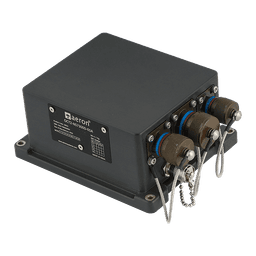
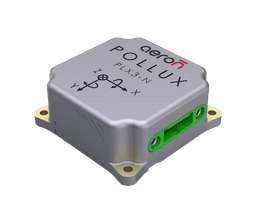
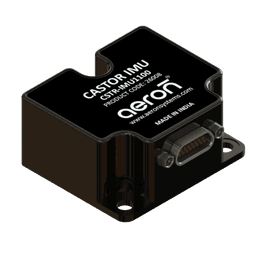
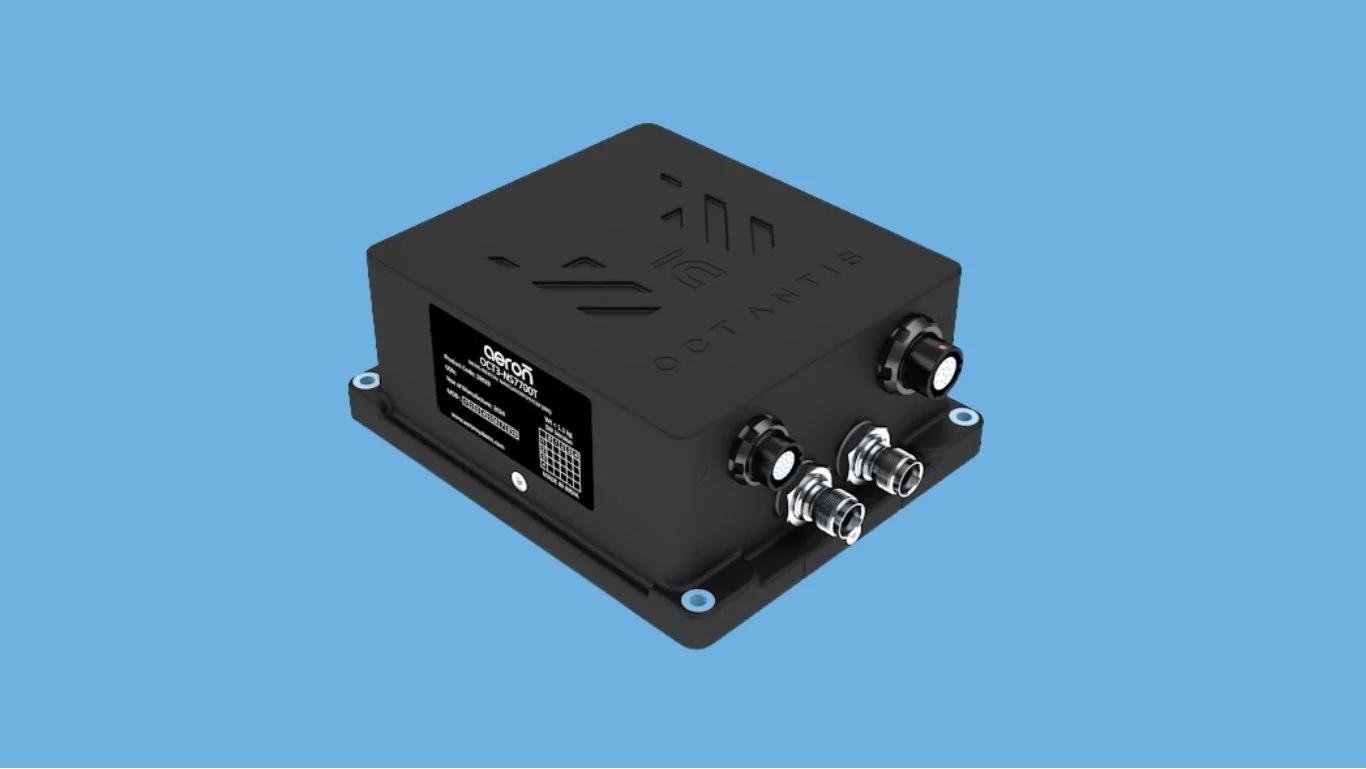
Aeron's Castor GYR1200 is a tactical-class triaxial MEMS gyro module with 0.6 °/hr bias instability, 0.1 °/√hr angle random walk and a ±480 °/s range, factory calibrated for bias and misalignment and compensated for temperature across its operating range. It survives mechanical shock up to 1500 g and outputs its data over RS422. MEMS gyroscopes are also at the heart of Aeron's Octantis and Pollux 3 inertial navigation systems and the Vega TSW-G tilt switch, which uses its gyroscope to measure angles reliably on vibrating machines.
How they compare
- MEMS: smallest, lightest, lowest power and cost; consumer to tactical grade. Best where size and cost dominate, or where GNSS or other aiding is usually available.
- FOG: larger and costlier; tactical to navigation grade. Best where long unaided navigation or high heading accuracy is needed.
- RLG: high stability, established in aircraft and strategic systems; larger and costly.
- Mechanical: historic and specialist uses today.
Choosing a gyroscope
Start with how long the system must hold its orientation without outside help, and how much angle error is acceptable at the end of that time. Divide one by the other and you have a rough bias instability to aim for. Then weigh size, weight, power, environment and budget. If you would like help with that calculation for your platform, talk to our engineers.