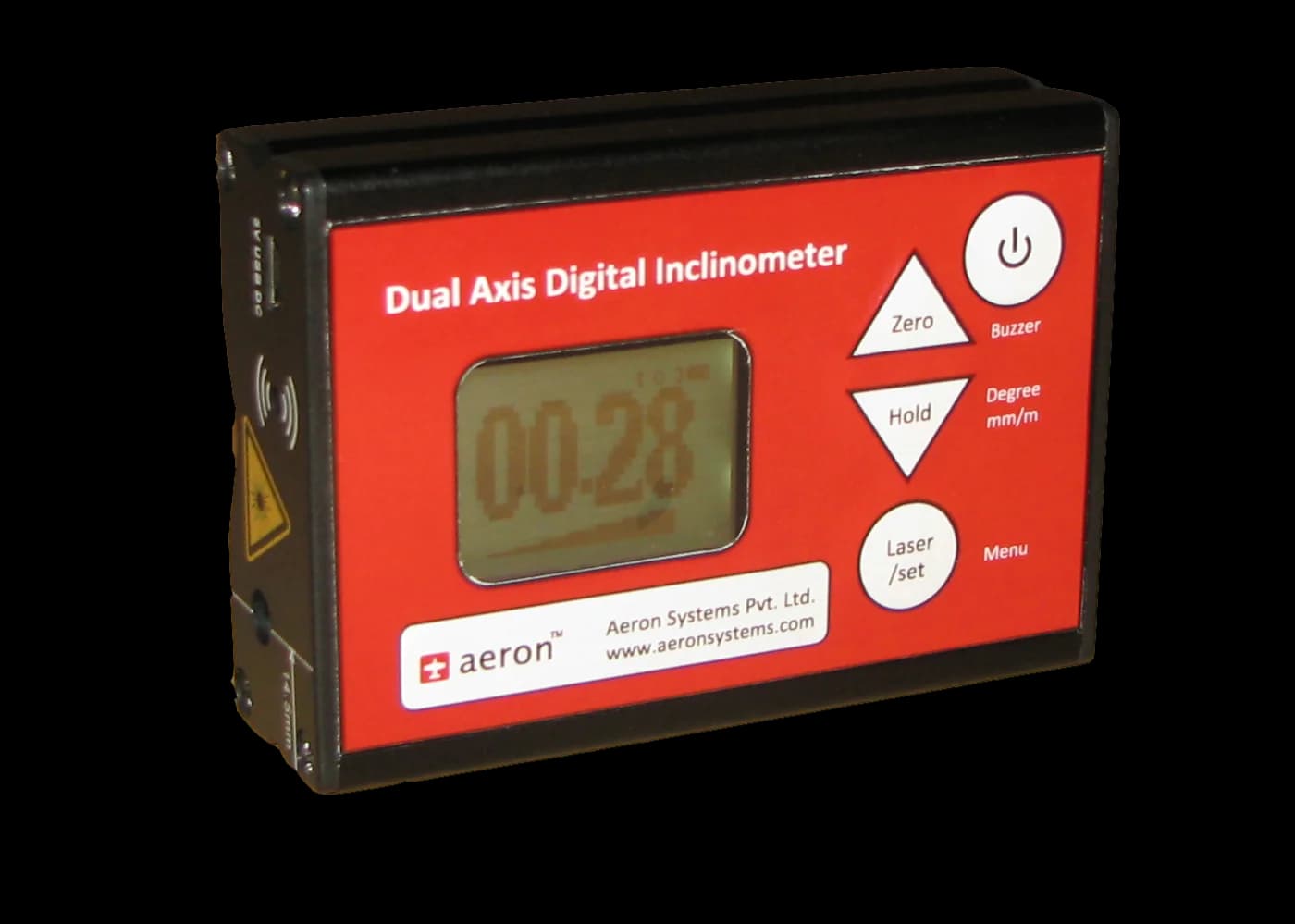
Construction depends on things being level, plumb and at the right angle: a crane's boom, a piling rig's mast, a paver's screed, a boom lift's platform, a precast element being set in place. For generations those angles were checked with spirit levels, plumb lines and a practised eye. Today an inclinometer can measure them continuously, feed them to the operator or the machine's controller, and stop the machine before a safe angle is exceeded.
What an inclinometer is
An inclinometer (also called a tilt sensor) measures the angle of an object relative to gravity. Most modern inclinometers use MEMS accelerometers: tiny silicon structures that sense the direction of gravity. From that direction the sensor works out two angles, commonly called roll (tilt from side to side) and pitch (tilt from front to back). A single-axis inclinometer measures one of these; a dual-axis inclinometer measures both.
The problem with vibration
An accelerometer cannot tell gravity from the vehicle's own acceleration. On a stationary structure that does not matter. On a working machine it does: engines vibrate, booms swing, tracks jolt over rough ground, and every movement adds acceleration that the sensor mistakes for tilt. A simple accelerometer-only inclinometer on a moving excavator can show angles jumping by several degrees.
The answer is to add a gyroscope. A gyroscope measures rotation rate and is not fooled by linear acceleration. By fusing accelerometer and gyroscope data with suitable filtering, a sensor can report a steady, accurate angle while the machine is moving and vibrating. This is the approach used in Aeron's Vega TSW-G, which combines MEMS accelerometers with a triaxial gyroscope and a 32-bit processor running statistical filtering to estimate roll and pitch in dynamic conditions.
Where inclinometers are used in construction
- Cranes: boom angle feeds the safe load indicator, which limits the load the crane may lift at each radius.
- Piling and drilling rigs: keeping the mast vertical, or at the designed rake angle, keeps piles and bores where the drawings say.
- Aerial work platforms and man lifts: the chassis must be level within set limits before the platform is raised.
- Dumper trucks and tippers: the body and chassis angle during tipping decide whether the vehicle stays stable.
- Road building: pavers and graders control cross-fall and slope with tilt sensors on the screed or blade.
- Structures: monitoring the tilt of retaining walls, formwork, towers and existing buildings next to an excavation, to catch movement early.
From measurement to protection: the tilt switch
For safety functions, a machine often needs not a number but a decision: stop when the angle passes a limit. A tilt switch is an inclinometer with relay outputs that switch when a threshold angle is crossed. The relay can cut hydraulics, sound an alarm or prevent a platform being raised. The Vega TSW-G has two relays, rated at 2 A up to 250 V AC, with switching limits the user configures up to ±90° in roll and ±60° in pitch, and it also reports the angles themselves over RS232 or RS485, in ASCII or Modbus RTU.
What to look for in an inclinometer
- Range: the angles you need to measure. Vega TSW-G measures ±180° in roll and ±60° in pitch.
- Accuracy, static and dynamic: accuracy on a still machine is easy; accuracy on a vibrating one is the real test. Vega TSW-G is specified at ±0.5° (1σ) static and ±1° (1σ) dynamic, with 0.01° resolution.
- Temperature stability: construction sites run from freezing mornings to hot afternoons. Look for factory calibration over the full temperature range and a stated temperature characteristic.
- Update rate and response: fast enough for the machine's movements. Vega TSW-G updates at 1, 10 or 20 Hz.
- Protection: sealing and shock survival for mud, water and knocks. Vega TSW-G is IP67, survives 20 g shock and operates from −40 °C to +71 °C.
- Interface: a serial or fieldbus output for the machine's controller, and relays where a direct safety cut-out is needed.
Installing for accurate readings
An inclinometer measures the angle of whatever it is bolted to, so mount it rigidly on a flat, clean surface of the structural member you care about, not on a bracket that can flex. Align its axes with the machine's axes, record its reading once the machine is known to be level, and use that as the zero. Check the zero after any repair or impact near the sensor.
For help choosing and configuring a tilt sensor or tilt switch for your equipment, talk to our engineers, or read how tilt switches protect cranes, man lifts and dumper trucks.