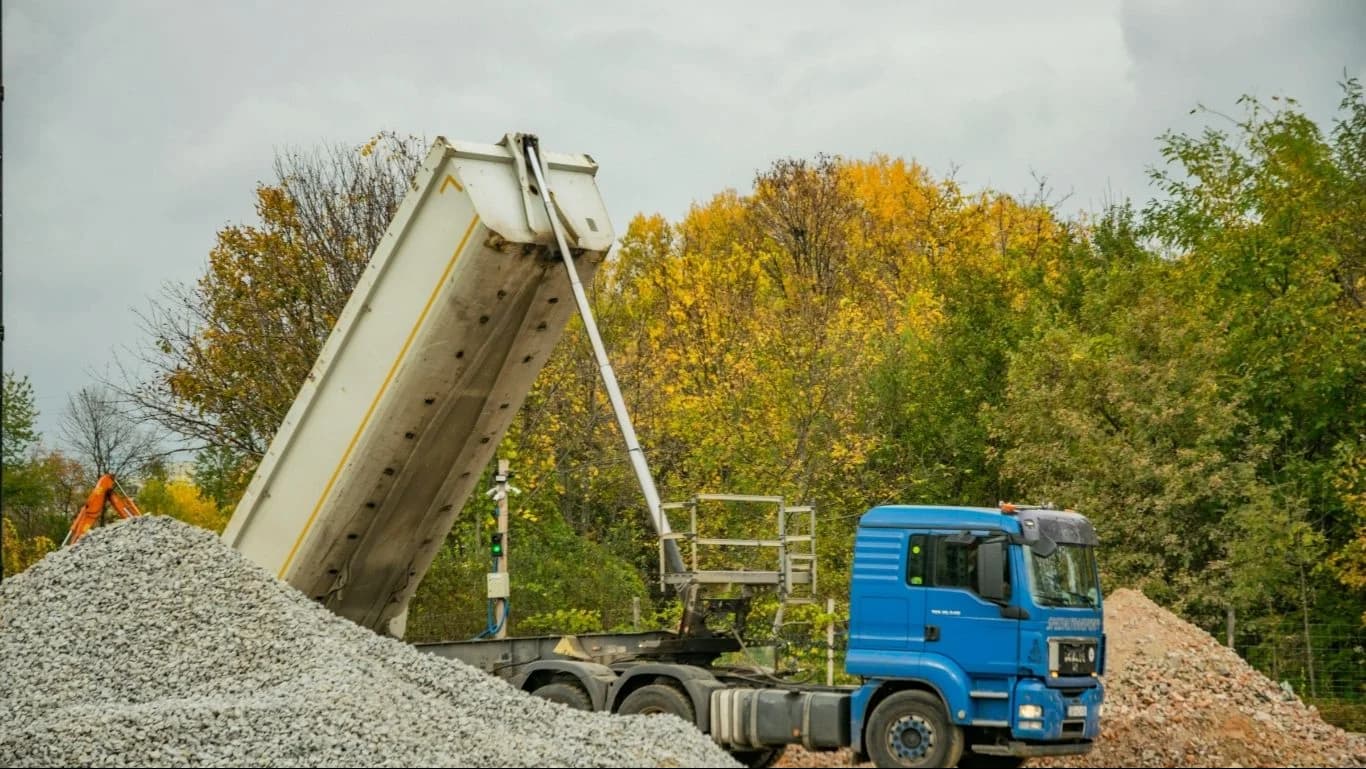
Cranes, man lifts and dumper trucks all have one danger in common: tipping over. Each works by moving a heavy load or a person away from its own centre of gravity, and each becomes unstable if it leans too far. A tilt switch watches the angle of the machine all the time and acts the moment a safe limit is crossed, faster and more reliably than an operator can.
Why these machines tip
- Cranes: the further a load is from the crane, the greater the tipping moment. Raising or lowering the boom changes the working radius, and a crane standing on uneven or soft ground starts with a tilt that eats into its safety margin.
- Man lifts and aerial work platforms: a raised platform puts people high above a small base. If the chassis is not level before the platform goes up, or the ground gives way, the whole machine can overturn.
- Dumper trucks and tippers: as the body lifts, the centre of gravity rises and moves. Tipping on a slope, an overloaded or unevenly loaded body, sticky material that does not slide out, or moving while tipping can all topple the vehicle.
What a tilt switch is
A tilt switch is a tilt sensor with switching outputs. The sensor measures the machine's angles, usually roll (side to side) and pitch (front to back). The switch compares them with limits set for that machine, and when a limit is exceeded it operates a relay. The relay can sound an alarm, light a warning, cut the hydraulic function that is making things worse, or stop a platform from being raised at all.
Because it acts through a relay, a tilt switch can protect a machine without any change to its control software, which makes it suitable for new equipment and for fitting to existing fleets.
Why vibration matters
Simple tilt sensors measure angle from the direction of gravity using an accelerometer. On a working machine, engine vibration, a swinging load or a truck braking all add accelerations that such a sensor misreads as tilt. The result is either false alarms, which operators soon learn to ignore or bypass, or a sensor filtered so heavily that it reacts too slowly.
Aeron's Vega TSW-G solves this by adding a triaxial gyroscope to its MEMS accelerometers. A 32-bit processor runs statistical filtering that combines the two, so the Vega reports steady roll and pitch angles even in vibrating and dynamic conditions. It is made for heavy equipment, dumper trucks, cranes and scissor lifts, and is factory calibrated over its whole temperature range.
How the Vega TSW-G protects each machine
- Cranes: the tilt of the crane base, and the boom angle for safe load indicators and boom angle indicators. A relay can stop a lift that would take the crane beyond its safe angle.
- Man lifts: the chassis angle before and during elevation. If the chassis is outside its levelling limit, the relay can prevent the platform from being raised, or stop it rising further.
- Dumper trucks and tippers: the chassis and body angle during tipping. The operator gets a warning as the limit approaches, and the relay can stop the tipping hydraulics before the vehicle becomes unstable.
Key specifications
- Measurement range: ±180° roll, ±60° pitch, with 0.01° resolution.
- Accuracy: ±0.5° (1σ) static, ±1° (1σ) dynamic.
- Two relay outputs, switching 2 A at up to 250 V AC or 220 V DC, with limits configurable up to ±90° roll and ±60° pitch.
- Angle output over RS232 or RS485, in ASCII or Modbus RTU, at 1, 10 or 20 Hz.
- IP67 sealing, 20 g shock survival, operation from −40 °C to +71 °C, and a 9 to 32 V DC supply for vehicle electrical systems.
A desktop application is available to configure the angle limits and outputs and to view the readings.
Setting it up well
- Mount it rigidly on the part of the machine whose angle matters: the chassis for stability, the body or boom for its own angle. Avoid brackets that flex.
- Align it with the machine's axes, so roll and pitch mean what the limits assume.
- Set the limits from the manufacturer's data for the machine's safe working angles, with a warning level before the cut-out level.
- Zero it on level ground and record the reading.
- Test the relay action at commissioning and at regular inspections, so everyone knows it works before it is needed.
Part of a safety system, not a replacement for one
A tilt switch does not replace operator training, load charts, ground preparation or outriggers. What it adds is a constant, objective check that does not get tired or distracted, and that acts in time. For machines that work near people, that is often the difference between a near miss and an accident.
To choose limits and a configuration for your equipment, talk to our engineers. See also how digital tilt sensors and switches are used in construction vehicle safety.