As utility-scale solar power becomes a cornerstone of global energy transition, data accuracy is no longer a desirable feature—it is an operational and financial necessity. The performance of solar photovoltaic (PV) plants is fundamentally influenced by environmental variables, and the ability to measure these variables precisely is central to optimizing generation, verifying plant efficiency, and maintaining investor confidence.
The IEC 61724-1:2021 standard sets the benchmark for performance monitoring of PV systems, classifying weather monitoring systems into Class A, B, or C based on data accuracy, reliability, and consistency. In this context, Class A weather monitoring stations emerge not just as instrumentation but as strategic infrastructure essential to asset optimization, risk mitigation, and financial viability of solar investments.
What defines a Class A Weather Monitoring Station?
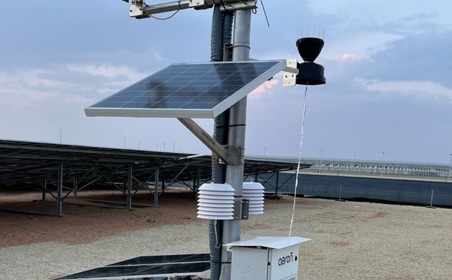
A Class A weather monitoring station, as defined by IEC 61724-1:2021, adheres to the highest precision, calibration, and installation standards, ensuring near-laboratory grade data acquisition in field conditions. These stations monitor a wide range of meteorological and plant-relevant variables, including:
Global Horizontal Irradiance (GHI)
Global Tilted Irradiance (GTI)
Diffuse Horizontal Irradiance (DHI) and Direct Normal Irradiance (DNI)
Albedo and Rear-Side Irradiance
Soiling Loss Index (SLI)
Module Temperature & Ambient Temperature
Relative Humidity, Wind Speed & Direction
To maintain their Class A certification, these stations must use Class A sensors, undergo routine calibrations as per international standards, and be installed in adherence to strict guidelines for shading, angular alignment, and mounting structures.
Why Class A Compliance Matters
1. Data Quality and Performance Analysis
Class A stations provide low-noise, high-resolution data, enabling
Accurate Performance Ratio (PR) calculation
Early fault detection (e.g., inverter clipping, module mismatch)
Climatic normalization for year-on-year comparisons
Soiling loss estimation, informing cleaning schedules, and revenue impact
Without Class A instrumentation, performance analytics are prone to error margins that can mask inefficiencies or exaggerate performance, leading to poor operational decisions.
2. Bankability and Financial Modelling
Bankability hinges on reliable, independently verifiable data. Financial institutions and insurance underwriters rely on this data to:
Build yield assessments and energy generation models
Validate revenue projections and return on investment (ROI)
Assess insurance exposure for performance guarantees
Only Class A stations offer the measurement fidelity required for investor-grade reporting. Projects relying on substandard data risk failing due diligence or facing conservative lending terms due to data uncertainty.
3. Risk Mitigation and Due Diligence
High-quality weather data is essential for:
Identifying seasonal anomalies
Analysing grid curtailment impacts
Evaluating degradation and availability losses
During M&A, refinancing, or operational audits, Class A data simplifies validation by third-party engineering firms. The lack of such data often triggers manual inspections or costly secondary verification campaigns.
4. Compliance with IEC and PPA Requirements
Increasingly, Power Purchase Agreements (PPAs) and regulatory frameworks demand adherence to IEC 61724-1:2021, particularly for international investors and multilateral-backed projects. Non-compliance may:
Jeopardize subsidy eligibility
Affect tariff indexing mechanisms tied to performance
Trigger penalties or disputes under PPA clauses
Aeron Systems: Engineering Bankable Data
Aeron Systems has engineered a portfolio of IEC 61724-1:2021 Class A compliant weather monitoring systems that are deployed across 35+ GW of solar capacity globally.
Highlights of Aeron WMS Solutions:
XTREME Series XG-930 Data Logger
o 24-bit ADC architecture
o Accuracy: ±0.01% of FS
o Protocols: Modbus TCP, RS485 RTU
o Seamless SCADA and cloud integration (Live3 platform)SIM100 Soiling Measurement System
o Complies with IEC’s Method 2 (short-circuit current)
o Real-time soiling ratio analytics
o Helps quantify energy losses and optimize cleaning cyclesCertified Systems
o EN61326, CE, RoHS compliant
o Third-party validated for global deployment
The robustness of Aeron’s Class A stations ensures minimal drift, long-term data stability, and zero compromise on environmental accuracy, even under harsh field conditions.
Bankability in Action: From Data to Capital
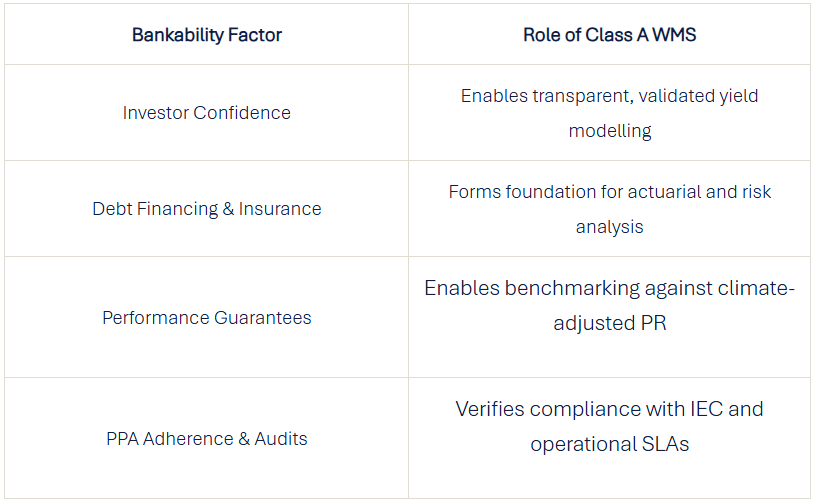
Class A WMS data is the currency of trust in solar finance.
Conclusion:
Class A WMS- The Foundation of a Bankable Solar Asset
As the solar sector matures, so must the instrumentation that underpins its credibility. A Class A weather monitoring system is not just a compliance checkbox—it is a strategic enabler of accurate energy forecasting, operational excellence, and financial confidence.
In an industry where a 1% yield deviation can shift millions in valuation, precision weather monitoring is non-negotiable. IEC 61724-1:2021 Class A compliance is no longer optional for developers aiming for premium financing, long-term sustainability, and transparent reporting.
With Aeron Systems’ proven WMS technology, project developers and asset owners gain not only precision instruments but also a platform of trust that accelerates approvals, de-risks portfolios, and strengthens investor relationships.