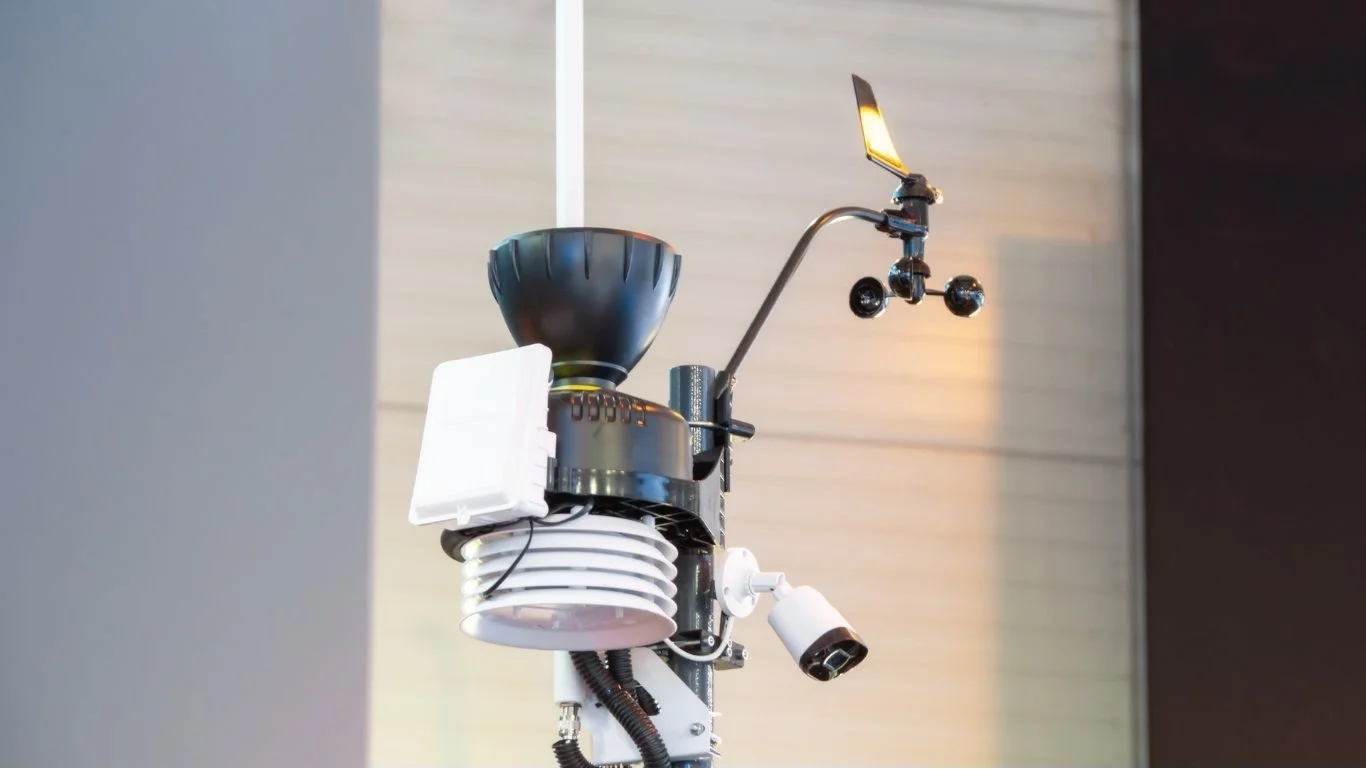
An automatic weather station (AWS) measures the weather at one spot, around the clock, without anyone reading instruments by hand. On a solar plant, those measurements are what the plant's output is judged against: if the sun was weak, low output is expected; if the sun was strong and output was low, something is wrong. This article walks through the parts of a station of the kind Aeron builds for solar and wind plants, and what each part does.
What a station has to do
Every automatic weather station does four jobs: sense the conditions, turn the sensor signals into numbers at the right moment, keep those numbers safe, and send them somewhere people can use them. For solar plants the international reference is IEC 61724-1:2021, which sets out what a monitoring system should measure and sorts systems into Class A, B and C by accuracy. Class A is the most demanding and is the class lenders and independent engineers usually ask for on utility-scale plants.
1. The sensors
The sensors are chosen for what the plant needs to know. On a solar plant the usual set is:
- Irradiance: pyranometers measure the sunlight arriving on a horizontal surface (global horizontal irradiance, GHI) and in the plane of the modules (plane of array, POA, or global tilted irradiance, GTI). Plants with bifacial modules add sensors facing the ground to measure albedo and rear-side irradiance.
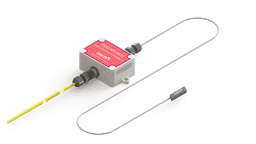
- Module temperature: a sensor bonded to the back of a module, such as Aeron's Rigel 2 with its PT1000 element, because a module's output falls as it gets hotter.
- Air temperature and relative humidity: a probe, usually inside a radiation shield, such as Aeron's Air Temperature and Relative Humidity Sensor (±0.2 °C and 1% RH measurement uncertainty, RS485 Modbus output).
- Wind speed and direction: for cooling of the modules, for tracker stow decisions and for safety.
- Rainfall: useful for understanding natural cleaning of the modules.
- Soiling: a soiling measurement system compares a clean reference module with one left to collect dust, to show how much energy dirt is costing. Aeron's Soiling Index Measurement System does this from the short-circuit current of the two modules, with a resolution of 0.01% on the soiling index.
Wind plants use a different set on a met mast: anemometers and wind vanes at several heights, air temperature, humidity and pressure, measured to IEC 61400-12-1.
2. The data logger
The data logger is the station's brain. It reads every sensor, converts analogue signals to digital values, time-stamps them and stores them. Its quality matters as much as the sensors': a very accurate pyranometer read through a noisy converter gives noisy data.
Aeron's Xtreme data logger, for example, uses a 24-bit analogue-to-digital converter with more than 20 effective bits, samples at 1 Hz and can log at intervals down to one second. It reads sensors over SDI-12, RS232 and RS485 Modbus, and keeps its clock right with a built-in GPS receiver, so every reading from every station on a plant carries a comparable time stamp. That matters when readings are compared with inverter and meter data minute by minute.
3. Storage
A station must not lose data when its connection drops. Aeron's stations keep readings on 8 GB of internal memory in CSV format, with a micro-SD slot for up to 32 GB more, which is enough for more than five years of records. When the connection returns, the missing period can be sent again.
4. Communication
The station sends its readings to the plant's SCADA system, to a cloud platform, or both. Common routes are Modbus over TCP/IP to SCADA, and Ethernet, Wi-Fi or 4G LTE to the cloud. Where legacy equipment has only a serial port, a gateway such as Aeron's FLINT WDG85 can carry its data over 4G.
5. Power and mounting
Stations run continuously outdoors, often far from a convenient socket, so they are usually powered from a small solar panel and battery or from the plant's auxiliary supply. The mast, the booms and the mounting of each sensor are part of the measurement too: a pyranometer that is shaded for an hour a day, or a module temperature sensor that has come loose, gives wrong numbers with no error message. IEC 61724-1 therefore sets rules for placement, alignment and cleaning as well as for the instruments.
6. Software
Finally, someone has to look at the data. A platform such as Live3 shows every station on a map with its status, calculates values like performance ratio from each reading, and raises an alert when a reading stays out of range or a station stops reporting, so a problem is found in hours rather than at the end of the month.
Putting it together
A station is only as good as its weakest part. Accurate sensors need a precise logger, a logger needs a reliable clock and storage, and all of it needs correct installation and regular cleaning and calibration. When those are in place, the station gives a plant owner a trustworthy answer to the question that matters most: given the weather, did the plant produce what it should have?
Aeron has designed and built weather monitoring systems since 2010. To discuss a station for your plant, contact our team or see WMS for Solar PV Plants.