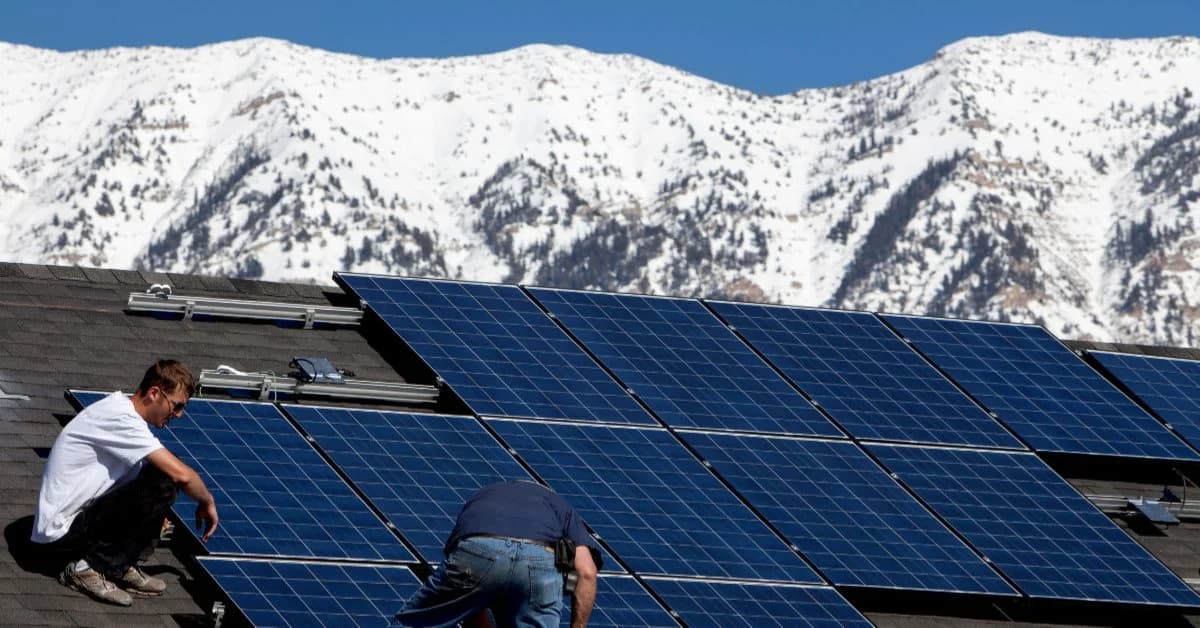
It surprises many people that solar panels work better in the cold. A crisp, clear winter day can produce some of the highest instantaneous output a plant sees all year. Cold climates also bring snow, short days and harsh conditions for equipment. This article explains what cold does to photovoltaic (PV) performance, what snow does, and how to measure both.
Why cold modules produce more
A solar cell's voltage rises as its temperature falls. Module datasheets express this as a temperature coefficient of power: for crystalline silicon modules it is typically in the range of about −0.3% to −0.5% per °C, measured from the standard test condition of 25 °C cell temperature. The sign is what matters: every degree below 25 °C adds output, every degree above takes it away.
Take a module with a coefficient of −0.4%/°C. On a hot day with the cells at 60 °C, it loses about 14% of its rated power to heat alone. On a cold, sunny day with the cells at 0 °C, it gains about 10%. That is a swing of roughly a quarter in output for the same sunlight.
The same effect has a design consequence. Because voltage rises in the cold, the string voltage on the coldest morning of the year is the highest the system will ever see. String lengths must be designed so that this voltage stays within the inverter's and the modules' limits.
Why cold places can still disappoint
- Short days and a low sun: at high latitudes in winter the sun is low, days are short and the energy available per day is small, even though each hour of sun is used efficiently.
- Snow cover: a module covered in snow produces little or nothing. How fast snow slides off depends on the tilt, the frame and the temperature.
- Ice and frost: a thin layer on the glass scatters light before it reaches the cells.
- Stress on equipment: electronics, cables, batteries and mechanical parts all have minimum operating temperatures, and repeated freeze and thaw is hard on seals and structures.
Why snow can also help
Fresh snow on the ground reflects most of the sunlight that falls on it, far more than grass or soil. That reflected light raises the irradiance reaching tilted modules, and it especially benefits bifacial modules, which collect light on their rear side too. At high altitude, where the air is thinner and often clearer, irradiance can also be high. The combination of cold cells, bright sky and reflective snow is why cold, sunny sites can post excellent performance on the right days.
Measuring what the cold is doing
To know whether a plant in a cold climate is performing as it should, its owner has to separate the weather from the plant. That takes a weather monitoring station that measures:
- irradiance on the horizontal and in the plane of the modules, and on the ground-facing side where modules are bifacial;
- module temperature, which in cold, windy weather can be far from the air temperature;
- air temperature, humidity and wind;
- soiling, including snow: a soiling measurement system compares a clean reference module with an exposed one, so it shows how much energy snow or dust is costing.
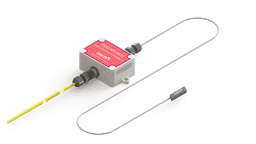
The equipment has to survive the conditions it measures. Aeron's weather monitoring stations are specified for operation from −40 °C to +80 °C, and its Rigel 2 module temperature sensors measure from −40 °C upwards with an IEC 60751 Class A PT1000 element.
A cold-climate example: Mongolia
Aeron supplied the weather monitoring station for a 5 MW solar plant with 3.6 MWh of battery storage in Mongolia, described as the country's first solar power plant with battery storage, built under the "Upscaling Renewable Energy Sector Project". Mongolia's annual average temperature is about 0.2 °C, with winter averages of −10 °C to −30 °C, so the sensors and accessories were chosen for those conditions.
The station measures global horizontal and plane-of-array irradiance, module and air temperature, humidity, wind speed and direction, and soiling from both dust and snow, with a lightning detection system. An Aeron Xtreme XG-930 data logger reads the sensors with its 24-bit converter and sends the data to the plant SCADA over Modbus TCP. The data also lets the owner study how snow cover affects generation. The station was deployed in June 2022. Read the Mongolia case study.
In short
Cold is good for the cells and hard on everything else. Plants in cold climates can perform very well, but only if their design allows for high cold-weather voltages, their equipment is rated for the temperatures, and their owners measure irradiance, module temperature and snow losses well enough to tell a weather problem from a plant problem. To talk about monitoring for a cold-climate plant, contact our team.